
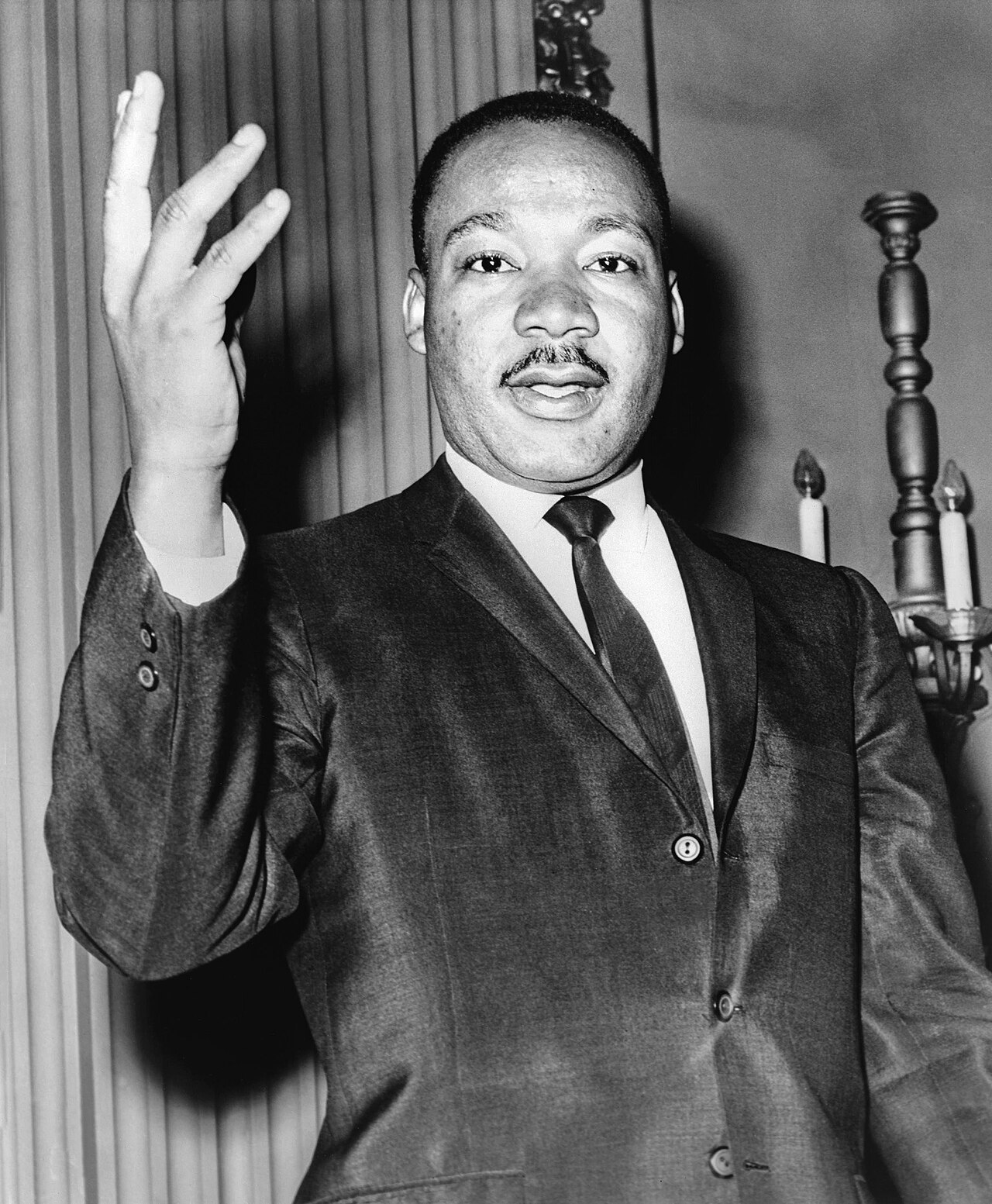
‘The arc of the moral universe is long, but it bends toward justice.’ Is it? Does it?

Written by Zofia Urbaniec
Before there was justice, there was only survival. Before there was morality, there was only hunger, cold, and a stranger on the other side of the river. The arc of the moral universe did not exist until we invented it, along everything else that makes us human: language, law, god, and greed. And what if justice is not our final destination but a direction? Civilizations have risen and collapsed, ideals have been proclaimed and betrayed, revolutions have liberated and destroyed. Yet at all times, humans manage to still be drawn toward fairness, equality, and peace. Whether that our purpose that we follow, or our own stubbornness in refusing to accept the world as it is, the arc does not bend on its own, it bends because we choose to bend it.
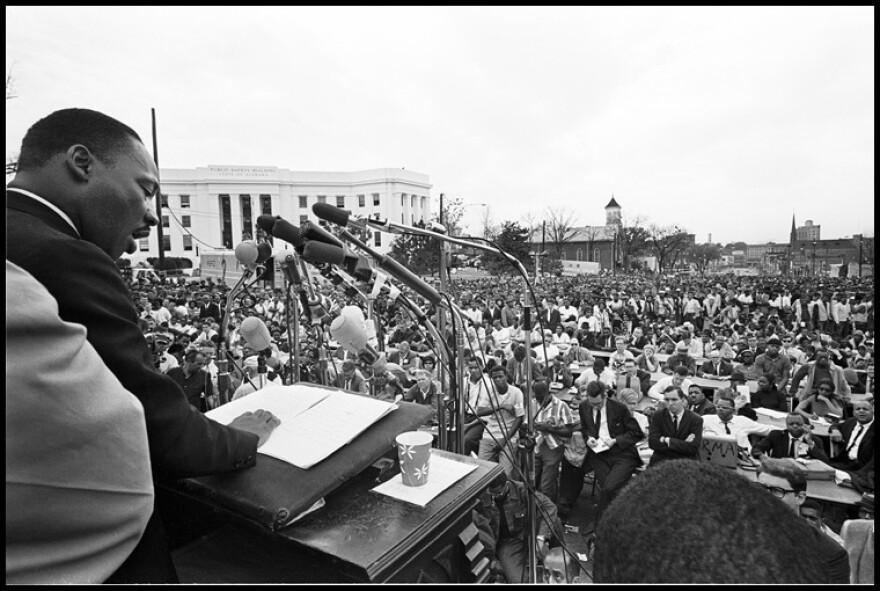
“How long? Not long, because the arc of the moral universe is long, but it bends toward justice” (King, 1965). These are the words said by the great fighter against racism and injustice Martin Luther King Jr. March 25th, 1965. He said them after tens of thousands of marchers had just completed a grueling 54-mile walk from Selma to the steps of the Alabama State Capitol. Along the way, they had faced state troopers, tear gas, and brutal violence. King had borrowed and adapted the idea from Theodore Parker, a Massachusetts Unitarian minister, transcendentalist, and one of the most radical white abolitionists in American history. Parker originally wrote: “I do not pretend to understand the moral universe; the arc is a long one… But from what I see I am sure it bends toward justice” (Parker, 1853). At a time when abolition seemed like a distant dream, the Fugitive Slave Act had just been passed, and slavery appeared more entrenched than ever, a century after Parker, and slaves abolition Martin Luther King used this phrase to give hope, to tell his fellow marchers how much longer they must wait for justice, freedom, and relief.
The word that King used “justice,” is one of the hardest words to define. Its meaning may vary depending on whether we ask a philosopher, a theologian, a lawyer or a sociologist. It may also depend on which side of a dispute we ask “What is just? ” A lawyer might answer that justice is responding to wrongdoing with proportional punishment, in order to prevent future crime. Put simply, this theory is supported by Kant, legal or religious systems such as Islam, Hammurabi’s Code, and criminal law worldwide.
The extension of this is a statement is what King meant in his speech – that justice is a fair division of all goods, burdens, and opportunities. He believed that the moral universe had made some progress since the beginning of its existence and that it would eventually lead to the victory of equality and love for one’s neighbor. That his fellow African Americans would finally be able to breathe a sigh of relief, and live their life as they wish. This theory is also associated with thinkers such as J. Rawls, R. Nozick, Aristotle, social democracy, and UN human rights frameworks, which indicates that it was not his individual thought, but it was backed up by philosophers, and legal and political systems (Rawls, 1971; Nozick, 1974).
Human history is so long and complex, in terms of both time and space, that we can never make fully positive statements or take a holistic view on the whole human universe, because each part has its own path towards moral progress. Between fifty and one hundred thousand years ago, our species, Homo sapiens, migrated out of Africa, and gradually spread across the globe. In response to different variations in climate “one race became many” (Fuller, 2012). Our primary purpose was survival , to preserve and extend the species. With the Neolithic Revolution, we evolved from hunters, to settlers. By that time, different tribes stopped recognizing one another as family, but as a strangeness and threats. We isolated and organized ourselves into a system of governance, eventually forming civilizations and communities. The capability to defend ourselves turned into a constant pursuit of power and resources.
With the arrival of humans, evil and immorality arrived as well. This is not because all humans are evil by nature or because human existence is unequivocal with evilness but because we define what is morally wrong and right; what is worth of punishment and what is worth of a prize. No such concepts had existed on Earth before. As Nietzsche claimed, morality is not a discovery but an invention and a system of values created by humans to serve human purposes. This was the beginning of the arc of the moral universe, it was no “superior force” behind it, it was us who created it. Every step forward, towards justice, has been shadowed by catastrophe, suggesting the arc is not merely long, but perhaps endless, and always ours to shape.
It might feel like any major success was followed by a bigger evil. Beginning with Ancient Mesopotamia, the creation of civilization, governance of city-states, and written law. Hammurabi’s Code in the 18th century BC created class distinctions in penalties that made inequality a legal standard for thousands of years. This pattern never truly disappeared. The mechanism simply changed where law openly assigned different punishments to a lord and a peasant, today the same effect is achieved through economic fines. A penalty equal in number, is not always equal in impact based on different economic capabilities. The form of equality shifted; the inequality itself did not.
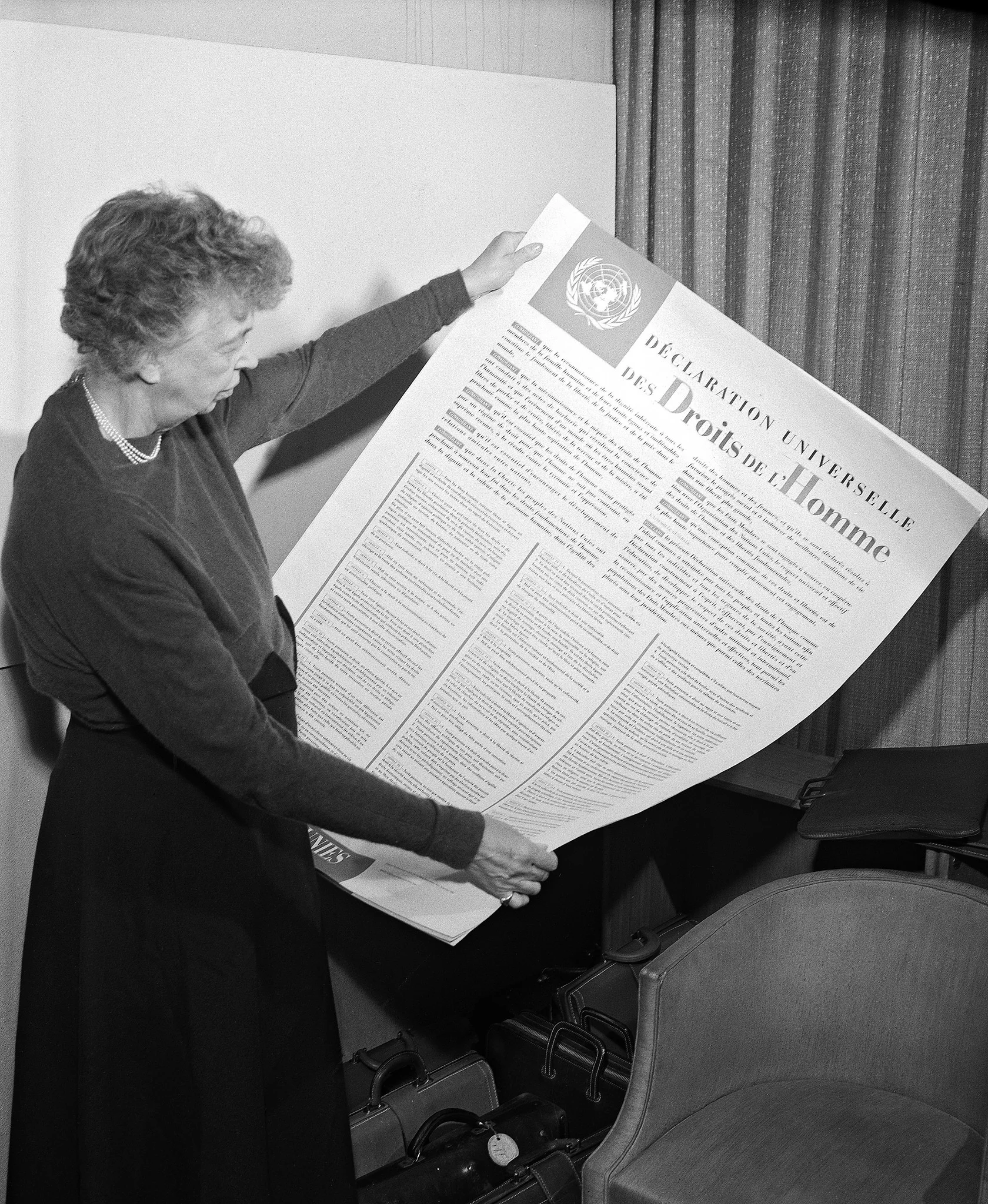
The language of moral progress and justice has always outpaced its practice. The 1948 Human Rights framework, laws were adapted to protect all genders, races, and minorities, yet they often remained only on paper. States signed them while simultaneously running gulags, apartheid, and colonial wars. The same countries that now lead technological progress remain complicit in genocides and the deprivation of human rights.
Humanity has always faced forks in the road, which are moments where the arc could bend toward justice or away from it. The Industrial Revolution became one of the most enormous pivots and multi-lateral achievements in history. Workers were exploited, the wealth gap grew enormously, and its consequences remain visible today. Today we face an even more complex and nuanced fork – Artificial Intelligence. Klaus Schwab calls the convergence of Artificial Intelligence, automation, and biotechnology the Fourth Industrial Revolution (Schwab, 2016). It cannot be ignored in relation to the arc of the moral universe. It does not only change how we produce things. It is affecting all disciplines, economies, industries and governments, and even challenging ideas about what it means to be human. We still have no idea how this kind of power will affect humanity. It used to be about military power, now it is about negotiation and money. It used to be about how many soldiers you had, now it is about how much data you collect and control, or how many rockets you can build. The direction we choose here will determine whether the arc bends toward justice or curves quietly away from it.

We can now make some expectations and predictions based on the past, but we can never measure or know anything for sure about the future. Popper warned that any theory claiming to know where history is heading is not science but myth, however Immanuel Kant was writing before any of this, nonetheless predicted the dynamic precisely (Popper, 1957). According to his philosophy, history is inclined by nature to the establishment of a “universal civic society” that administers justice universally (Kant, 1784). He argued that nature uses human selfishness as a driving force. Humans have a simultaneous desire to live in society, because we need others, and a desire to isolate ourselves, to compete and seek dominance. This friction pushes humanity to build laws, sciences, culture, and civilization. Kant called this “unsocial sociability” (Kant, 1784). He envisioned a federation of free, independent, and republican nations that would effectively resolve international disputes through diplomacy rather than continuous, bloody wars. For Kant, history is the grand theater where human freedom is slowly realized. The end goal of this historical progression is moral.
This vision has some similarities with what Martin Luther King Jr. proclaimed: “a society of justice where none would prey upon the weakness of others; a society of plenty where greed and poverty would be done away; a society of brotherhood where every man would respect the dignity and worth of human personality”(King, 1965). This is what society aims for and calls morally pure and most ambitious. However, this model has never fully existed, even at the very beginning. Achieving this level of general harmony and peace would require almost biblical lack of sin and evilness.
Francis Fukuyama, writing after the Cold War, went even further than Kant. He claimed that liberal democracy had won, that humanity had finally reached its destination, and the arc had stopped bending because justice had arrived (Fukuyama, 1992). History’s great ideological battles were over. Yet reality proved him wrong almost immediately: ethnic cleansing in the Balkans, genocide in Rwanda, the return of authoritarianism across the globe, and democratic backsliding that continues today. His theory is most valuable not where it succeeded, but where it failed. It showed us that progress assumed is progress abandoned. There is no final destination we automatically inherit. Justice is not something history delivers to us, it is something each generation must actively choose.
It seems as if what we all yearn to achieve is The Golden Rule: regardless of status, role, or background, every person deserves the same respect and consideration. In Hinduism it is expressed in the Mahabharata as “अहिंसा परमो धर्मः”, meaning “non-violence is the highest duty,” In Buddhism the Dhammapada teaches “सब्बे सत्ता सुखी होन्तु,” meaning “May all beings be happy. Confucius states “己所不欲,勿施于人,” meaning “What you do not want for yourself, do not do to others.” The Talmud teaches “דעלך סני לחברך לא תעביד,” meaning “What is hateful to you, do not do to your fellow.” Jesus “Do unto others as you would have them do unto you.” In Islam, the Prophet Muhammad says “لا يؤمن أحدكم حتى يحب لأخيه ما يحب لنفسه,” meaning “None of you truly believes until he loves for his brother what he loves for himself.” In Roman law it appears as “neminem laedere,” meaning “to harm no one.” In modern philosophy Immanuel Kant formulates a related principle in his Categorical Imperative as “Act only according to that maxim whereby you can at the same time will that it should become a universal law.”
All this shows how every culture aims for the highest form of moral progress, which is complete equity. It also shows how this is considered as a utopia, something that humans can only try to achieve but may never fully reach . For what would the purpose of the moral universe be, if not achieving purity and eternal peace? Every major civilisation, independently, arrived at the same principle. That is not coincidence – it is the closest thing we have to evidence that the arc and its destination is real.
The truth is, we are our own navigators, we have created the arc, and we can control it. We do have a special trait that has been with us from the very beginning: greed for power and resources. We may only see the arc because we cherry-pick the victories; for every milestone toward justice, there are catastrophes. We are standing before another fork. Our generation will decide the next tremendous change in history, morality, and mentality of all humans. So is the arc of the moral universe bending towards justice? Yes — but only if we, as humans, make the collective effort to shape it. Is it long? Yes, perhaps even endless. The arc does not bend on its own. It never has.
What to read next?
- Bibliography
- The Better Angels of Our Nature — Steven Pinker
- Justice — Michael Sandel
- The Righteous Mind — Jonathan Haidt
- Moral Tribes — Joshua Greene
- Sapiens – Juwal Noach Harari
- Enlightenment Now — Steven Pinker
- Humankind — Rutger Bregman
- The Brothers Karamazov — Fyodor Dostoevsky
- Lord of Flies – William Golding
- 12 Angry Men (film)
- “I Have a Dream” Speech by Martin Luther King Jr. at the “March on Washington,” 1963
Bibliography:
Baldwin, Lewis V. 2011. The Arc of the Moral Universe and Other Essays. Cambridge, MA: Harvard University Press.
Aristotle. 2000. Nicomachean Ethics. Translated by Roger Crisp. Cambridge: Cambridge University Press.
Butterfield, Herbert. 1931. The Whig Interpretation of History. London: G. Bell and Sons.
Confucius. 1979. The Analects. Translated by D.C. Lau. London: Penguin Classics.
Fuller, Robert W. 2012. “The Moral Arc of History.” Cadmus: Journal of the World Academy of Art and Science 1 (4). cadmusjournal.org.
Fukuyama, Francis. 1992. The End of History and the Last Man. New York: Free Press.
Kant, Immanuel. 1991. “Idea for a Universal History with a Cosmopolitan Purpose.” In Kant: Political Writings, edited by H.S. Reiss. Cambridge: Cambridge University Press. (Originally published 1784.)
Kant, Immanuel. 1991. “Toward Perpetual Peace.” In Kant: Political Writings, edited by H.S. Reiss. Cambridge: Cambridge University Press. (Originally published 1795.)
Kant, Immanuel. 1998. Groundwork of the Metaphysics of Morals. Translated by Mary Gregor. Cambridge: Cambridge University Press. (Originally published 1785.)
King, Martin Luther Jr. 1965. “Our God is Marching On.” Speech delivered at the Alabama State Capitol, Montgomery, Alabama, 25 March. kinginstitute.stanford.edu.
Nietzsche, Friedrich. 2006. On the Genealogy of Morality. Translated by Carol Diethe. Cambridge: Cambridge University Press. (Originally published 1887.)
Nozick, Robert. 1974. Anarchy, State, and Utopia. New York: Basic Books.
Parker, Theodore. 1853. Ten Sermons of Religion. Boston: Crosby, Nichols and Company.
Popper, Karl. 1957. The Poverty of Historicism. London: Routledge and Kegan Paul.
Rawls, John. 1971. A Theory of Justice. Cambridge, MA: Harvard University Press.
–
United Nations. 1948. Universal Declaration of Human Rights. New York: United Nations. un.org/en/about-us/universal-declaration-of-human-rights.
Hammurabi. c.1754 BCE. The Code of Hammurabi. Translated by L.W. King. New Haven: Yale Law School Avalon Project. avalon.law.yale.edu.
Sahih Muslim. 1972. Hadith No. 45. Translated by Abdul Hamid Siddiqui. Beirut: Dar Al Arabia.
Schwab, Klaus. 2016. The Fourth Industrial Revolution. Geneva: World Economic Forum.
The Bible. 1989. New Revised Standard Version. New York: HarperCollins.
The Dhammapada. 2005. Translated by Gil Fronsdal. Boston: Shambhala Publications.
The Mahabharata. 2009. Translated and edited by John D. Smith. London: Penguin Classics.
The Talmud: Tractate Shabbat 31a. 1989. Translated by Adin Steinsaltz. New York: Random House.
Related Articles
Related
„Łuk moralnego wszechświata jest długi, ale pochyla się ku sprawiedliwości”. Czy tak jest?
Zastrzeżenie: Wersja przetłumaczona, dlatego zachęcamy do sięgnięcia po oryginał.Zanim istniała sprawiedliwość, istniało tylko przetrwanie. Zanim istniała moralność, istniały tylko głód, zimno i obcy po drugiej stronie rzeki. Łuk moralnego wszechświata nie istniał,...
Trackbacks/Pingbacks